Fall 2018
This is a “specialized” course if taken for the Psychology Major.
Contact — E-Mail: william.mace@trincoll.edu
Personal Website
Required Reading
Books — E. H. Gombrich, Art and Illusion
Lawrence Weschler, Seeing is Forgetting the Name of the Thing One Sees
Robert Morris drawing lessons from Josef Albers
Reading for this course is extremely important. The core reading E. H. Gombrich’s book, Art and Illusion, is interesting and provocative. It should make you think about a great deal that you have not thought about before. For the reading to work its magic, you have to cooperate by giving it substantial hunks of time. When you get a “reading” assignment, the goal is for you to have learned the material in the reading, not just to have passed your eyes over each page once or twice. To emphasize this,for the first several assignments, I did not say simply “read” but “read, learn and digest.” You ought to approach any reading assignment this way, but sometimes people do not, so I’ll say it more explicitly and more often.
There are 29 pages in the introductory chapter of Gombrich. This Introduction, called “Psychology and the Riddle of Style,” is divided into six sections with Roman Numeral headings. There are 61 paragraphs. Some of the paragraphs are short transitions to the others. Some are long and dense with information. For carefully presented and argued material like this, it is not unreasonable to guess that an average of 5 minutes per paragraph is minimal to get what you need to get. If we round the number of paragraphs to 60, then we’re talking 300 minutes already for the chapter. How long is that? How many minutes in an hour? Good. So how many hours? That’s not counting the pictures. The topics at hand concern what can be seen in pictures, so the pictures in the book are there to make a point. You need to look carefully at the pictures, see what you see, and understand what the point is meant to be. Do they succeed in making the point for you? There are only 4 pictures in this Introduction. What are they? Why are they there? Integrating those into your understanding takes some more time. Putting it all together, I’d say that 6 hours is a reasonable beginning for the amount of time to allocate to this introductory chapter.
QUESTIONS AS IMPORTANT AS ANSWERS
Sometimes students approach a course as a source of answers, thinking that the goal of a course is to teach students what experts know about a topic. The surprise for students is that what they often find is that much of a course is about what experts ASK about a topic. Much of any discipline involves learning how people package their questions in order to make progress. The questions you have when you are not an expert don’t necessarily lead to answers that look like they address the question you had.
Consider the Introduction. The title is “Psychology and the Riddle of Style.” A riddle is a kind of question, so we’re already orienting to questions. Because that’s the main topic, you ought to start reading, thinking to yourself “What is the riddle of style?” or even, “Can there be more than one riddle of style?” And, “what does Gombrich think the Riddle of Style is?” So you don’t just plunge in, but you plunge in knowing some of what you have to look for. In past classes, I have asked students, AFTER several class sessions, and AFTER doing the reading, what the Riddle of Style was to Gombrich. The reply of some was a list of styles. But I didn’t ask what some styles were or even what was meant by style. I asked, with Gombrich, what the “Riddle of Style” was. You cannot appreciate the riddle of style without good examples in mind, but those examples are not themselves what the question asks.
The first sentence says “The illustration in front of the reader should explain much more quickly than I could in words what is here meant by the “riddle of style.” See — Gombrich directly addressed the main point right from the beginning — but he also asked you to look at the first Figure. So you have to look at the Figure. Do you get the joke? Is it funny to you? If so, why? Gombrich’s second sentence says how important the cartoon is as an illustration of what he’ll get to, then he asks a question. Gombrich asks SIX questions in the first paragraph, and SEVEN in section I. You’ve got to stop and think about each question in order. (1)”Why is it that different ages and different nations have represented the visible world in such different ways?” Does that sink in as a real question? Can you think of some possible answers? At least to illustrate what the question is about?
What I’m try to do here is to alert you to the level of detail to be grasped and the tempo required to grasp it. If you do that, then you’ll participate well in class and write your papers at the correct level.
Course Work
Grades will be based on written work (90%) and class participation (10%).
Class participation will be based on attendance, your willingness to talk in class, and performance on occasional exercises that I’ll call “homework.”
Papers
Your main written work for the semester will be a series of 4 modest papers and a more comprehensive final paper.
The assignments and dates due are these:
| Schedule of Classes | ||
| DATE | READING FOR CLASS | TOPIC DESCRIPTION |
| Class 1 | Examples of Styles Preface to 2000 edition of Art and Illusion | Introduction to the course |
| Class 2 | Read, Learn and Digest: Gombrich — Introduction: Psychology and the Riddle of Style Mirror demo | Introduction to the scope of visual arts. Experiences in art. Role of the observer. Who can see what and when? Alain cartoon Overview of issues, Gombrich style. Peruse some more Egyptian Art. Just Google “Egyptian Art.” |
| Class 3 | Read, Learn and Digest: Gombrich — Chapter 1 Wivenhoe Park series In class: Amount of light in different conditions Light variation due to reflectance One of Alan Gilchrist’s Gelb demos | Assignment 1 due a week from today, Sept. 18 |
| Class 4 | Read, Learn and Digest: Gombrich — Chapter 2 Inness Lackawanna Wolgemut p. 81v Check this out from Science, Sept. 5, 1997 Mystery Figure Revelation | pay attention to the word “schema” and the idea of “schema and correction” |
| Function and Form | ||
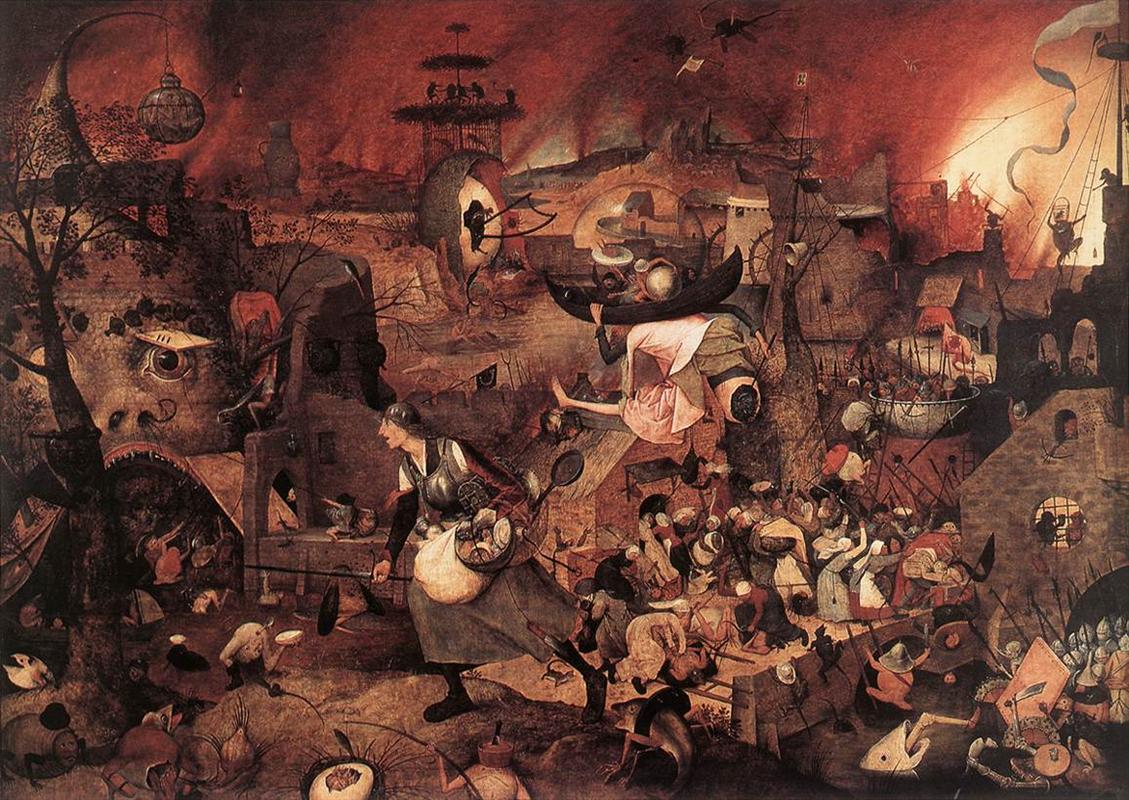
| Class 5 | Read, Learn and Digest: Gombrich — Chapter 3 Brueghel’s Dulle Griet Part of Plato’s REPUBLIC (Book X) cited in Gombrich J. S. G. Boggs Platonic Solids | Assignment 1 due by 10 tonight “Making comes before matching” |
| Class 6 | Read, Learn and Digest: Gombrich — Chapter 4 First Greek sculptures in Chapter 4 | The role of considering the function (purpose) of art in interpreting why it looks the way it does. From Egypt to early Greece to classic Greece — and then jumping to medieval Europe. Progress? |
| Class 7 | Read, Learn and Digest: Gombrich — Chapter 5 Mondrian works. Look especially at the development of his “trees.” See beginning of Morris art lesson video | The Robert Morris video is linked to your Moodle page. At the bottom of the left hand column, after all the dates, is a line labeled Kaltura Media Gallery. Click on that. One video should show up to click on. |
| The Beholder’s Share | ||
| Class 8 | Begin Gombrich — Chapter 6 Frank Gehry Sketching Video (Robert Morris) | |
| Class 9 | Read: Gombrich — Chapter 7 Brian Rogers on Illusion Neon Color Spreading Experiences like Gombrich’s at the beginning of Chapter VII. Julian Beever anamorphic trompe l’oeil sidewalk chalk art Brusspup anamorphs Sandor Vamos Art | |
| Class 10 | Famous Steinberg Peter Rose video | Assignment 2 due a week from today, Oct. 11 |
| Class 11 | Read: Gombrich — Chapter 8 Hogarth False Perspective 1754 Gibson on what lines can do Gibson’s Psychology of Representation Gibson’s 1978 revised theory of pictures Perspective Rotation Bonus — see New Yorker article about Berenson on Moodle site Painting at issue in Hahn case | |
| Class 12 | Continue: Gombrich — Chapter 8 Gibson Readings Gombrich’s review of a biography of Gibson by Edward S. Reed, who was a 1975 graduate of Trinity. See more about Reed here Alberti perspective Perspective Tutorial Evansville Perspective lessons How the horizon works Perspective “distortion.” Big perspective website. Includes previous photo. | |
| Class 13 | How the horizon works Perspective “distortion.” Big perspective website. Good for review Vermeer — perspective Perspective PowerPoint | |
| Invention and Discovery | ||
| Class 14 | Read: Gombrich — Chapter 9 Gibson film 61 MB A figure and change Another figure and change Gibson’s last theory of pictures | |
| Class 15 | Notes to remind you about last class Gibson memo on affordances | |
| Class 16 | PowerPoint from class with 2 occlusion demonstrations over a painting — now on Moodle Size of image on window Artist with computer routine for caricature — On Moodle site Painting size experiment | |
| Class 17 | Read: Gombrich — Chapters 10 & 11 Artist’s advice on caricature drawing Caricatures to study Shaw face project based on orthodontic theory of Harvey Jenkins and biology of D’Arcy Thompson — see Moodle for paper led by Len Mark, and another led by John Pittenger. The original Harvey Jenkins source is there as well. This work is all about the Gibson style approach of pairing change and non-change; invariants and variants. | |
| Robert Irwin and James Turrell | ||
| Class 18 | Completing story of the growth transformation of Shaw Todd et al 1980 When is a painting finished? Presentations about artists in the article above PowerPoint list for above article Read: Weschler Chapters 1 – 5 | Assignment 3 due a week from today, Nov. 13 |
| Class 19 | Read: Weschler — Chapters 6 – 9 Irwin Video in class Robert Irwin at the University of Virginia Robert Irwin with Lawrence Weschler in Chicago | |
| Class 20 | Read: Weschler — Chapters 10-13 Los Angeles County Art and Technology Project San Diego “Light and Space” Pacific Standard Time Website Irwin’s theory of the History of Art | Nathan Knobler theme of art making in terms of decisions to be made. Irwin, Turrell and Science (LA County) Irwin lines — Beholder’s share? Who is the audience? How many can there be? Look at Irwin’s history as an observer — Ibiza, Paris, lines, dots, etc. |
| Class 21 | Finish Weschler Dia Beacon Robert Irwin information Robert Irwin reception for Pace show July, 2012 Friend and colleague Irwin in Marfa, TX (Irwin’s part is at about 14 minutes in) | |
| Class 22 | Recommended resource. Skim to see what is here. Craig Adcock 1990 book on Turrell New Turrell website Useful overview as of 2018. Required (next 4 items plus video): Adcock on ideas for Roden Crater 1989 Light and Space 1994 Times article on Roden Crater 2007 NY Times article 2013 | Watch 1995 French video about Turrell on Kaltura site on Moodle |
| Class 23 | Continue to study the set listed for last time. Mainly, we’ll proceed with film, using the resources below. Assignment 4 — Due December 4 | Assignment 4 due a week from today, Dec. 4 |
| Film | ||
| Class 24 | Rich sample in recent YouTube High School Video Competing suburban Seattle HS Forward version The “competing” video above was made to be shown backward. This link labeled “Forward version” shows how that video was made. Bordwell, Gombrich, and. . . What? Bordwell chapter Gibson chapter on film Cutting Chapter Dolly sample Zoom sample Making the Copacabana shot in Goodfellas by Martin Scorsese Reverse tracking or “vertigo” shot | |
| Class 25 | Review Gibson chapter (above) Review Cutting chapter (above) Editing — with montage Kuleshov effect and montage Christopher Nolan films Koyaanisqatsi trailer Mentioned in Cutting chapter Perceptual motion phenomenon based on Johansson and Runeson. From Trinity senior thesis. Now related to “motion capture.” Example of “event perception” mentioned in Gibson chapter. The SteadiCam and how to use it Finally: Look for “How Hollywood Does it” video on Kanopy, accessible through Trinity Library. | |
| Class 26 | Sol LeWitt at Trinity Sol LeWitt: For video, check the Trinity Library listings for the videos 1. “Sol LeWitt: Wall Drawings” which is about Mass MOCA, and 2. “Sol LeWitt: 4 Decades.” These are in Kanopy for streaming. Carl Andre at Dia: Beacon Fred Sandback at Dia Beacon The Society for Cognitive Studies of the Moving Image | New resource for you to know about: Cutting, J. E. & Armstrong, K. L. (2018). Cryptic Emotions and the Emergence of a Metatheory of Mind in Popular Filmmaking. Cognitive Science, 42, 1317-1344. DOI: 10.1111/cogs.12586 |
 Ecological Psychology and Homeokinetics